Great Plains
The Great Plains (also known as the Great Plains States) is a region of the United States of America.
Overview
Formed after The Collapse, the Great Plains States are made up of the states of Iowa, Minnesota, Montana, Nebraska, North Dakota, South Dakota, and Wyoming.
History
The Great Plains States were, by and large, spared from the worst ravages of the past couple of decades. Of course, they didn't come through those dark years smelling like a rose-no one did. But the Great Plains states didn't have the volume of problems that others bore.
In the mid-to late-1990's the Great Plains region was hit with several years of drought, which made life very hard for everyone in the area. Water was strictly rationed and food was scarce, yet most of the residents continued to be able to scrape out a living.
When the Collapse hit, the region was still parched. For that reason, most of the nomads and aimless wanderers avoided the area. No one particularly wanted to cross endless miles of dry, flat plains with no hope of water or a city where jobs might be found. They headed instead to the metropoli, and to places with better weather. This couldn't have pleased the residents more. They were happy to struggle on their own and let the rest of the nation deal with its problems elsewhere.
There were a few migrants passing through, o f course; generally the residents turned a cold shoulder to them, knowing that with towns so few and so small, the migrants would be unlikely to find help elsewhere, either. It is said that even today, abandoned cars can be found on back roads, some with the remains of Nomads still nearby.
During this time, agribusiness corporations began buying up the land of these states, which was being sold at pennies to the dollar. While it was not yet feasible or economic to farm the area on the scale they were envisioning, the agricorps were strengthening their position for the future. Some new agribusiness communities began construction around this time, scheduled to begin full-scale farming around the tum of the millennium. By that time it was projected that the lingering effects of the drought of '98 would be gone and there would be enough water to go around.[1]
The Brushfire
Unfortunately for all, in the early summer of the year 2000, a major catastrophe occurred: The Brushfire. The simplicity of the name cannot convey the raw power it had and the terror it inspired. The Brushfire was a conflagration the like of which has never been seen. It burned huge portions of Montana and North Dakota, and visited other states as well.
Most people believe that The Brushfire was started by a careless Nomad pack somewhere on I-94 in eastern Montana. It is the most likely explanation, and if the Nomads weren't killed in the fire, they certainly aren't going to talk about it.
I-94 is a 250-mile stretch of road leading from Billings to North Dakota. According to the best estimates, the fire started here and fed itself rapidly on the dry brush in the area. Eventually, the smoke plume was spotted in Billings, and Leslie Sanstone, a low-ranking agribusiness corporate, drove out to investigate. She found the fire before she'd gone ninety miles, and it had already leapt across the interstate.
Sanstone's secretary had brought his camcorder and shot some of the most famous footage of the fire. By that time, it had become a firestorm, with thermal convection pulling in oxygen from around the flames and fueling them to blast furnace temperatures. For those with access to the film, note the steady breeze whipping Sanstone's dress as she narrates the video.
The breeze from the thermal convection kept the fire from spreading as fast as it perhaps could have. Since the fire was pulling in air from around itself, it was having to spread upwind in all directions. However, the fire had also burned away all the fuel in the center, taking on a ring shape, and was large enough that it was beginning to affect the weather conditions in the immediate vicinity. Eventually the fire calved, and, aided by a high-pressure zone which had moved in from the west end of the state, became several fire curtains which swept across the land.
A fire curtain is a terrifying thing. It's a long line of burning fuel, pushed in one direction by prevailing winds. The winds provide plenty of oxygen for the fire to consume, and then carry the heat downwind, where it preheats the brush for the fire to ignite next. The concept had been known for some time, and was even used in the firebombing of Japanese coastal cities, but a fire curtain the size of The Brushfire had never been seen.
The Brushfire found some of the agricorp land-gargantuan fields, untended and dry-awaiting next year's planting. Coaxed by the winds, it consumed countless thousands of acres. Normal fire-fighting tactics were useless before the fire, as its size outweighed anything the enfeebled states could pit against it, especially as they were hamstrung by water shortages.
The U.S. Army was finally called in to cut a dead area in North Dakota, where The Brushfire had finally spread. The Army efficiently destroyed an incredible amount of area, burning wood and grass in controlled fires, digging firebreaks, and sowing chemicals to further retard the fire.
Finally, the fire found itself trapped between this dead zone and the Missouri river in North Dakota, and, after a long, hard fight, burned itself out. Although the fire jumped the river in a few places, Army troops and Corporate workers managed to keep it in check.
There were also many other fires started by ashes (and entire bushes) carried aloft by The Brushfire, some as far away as Wyoming and South Dakota. All told, there were approximately fifty seven separate fires in this disaster.
Even once extinguished, The Brushfire still had an effect on Great Plains life. The incredible amounts of heat and smoke generated disrupted the local weather for the rest of the year, and falling ashes hampered the plant life and fouled mechanical devices. Asphalt roads had bubbled up under the heat and had to be rebuilt. The list goes on and on.
The most dramatic effect of The Brushfire, though, was on the attitude towards Nomads and the like. Nomads were blamed for igniting The Brushfire, perhaps with a cigarette butt or a campfire, and any homeless wandering the Great Plains roadways were all considered to share in the guilt. Vigilantes started attacking Nomad packs and homeless people on the 'ounce of prevention' philosophy, and most of the states passed very strict migrant laws. As word of this spread through the country, the various people roaming the nation's highways found better places to go, and the Great Plains were rarely bothered by Nomads again.
Modern Times
Since then, the Great Plains has rebuilt, and with the warming global climate, it had become the new breadbasket of the United States. Most of the area is dominated by gigantic agribusiness cooperatives, which farm vast open areas from their new city bases.
Of course, just because the countryside looks pastoral doesn't mean there's no fighting going on. The agricorps regularly field small hit teams for select sabotage, although each is careful not to ignite any fires. They also try to harvest each other's fields whenever possible. Similarly, there is constant friction between the agricorps who try to dominate the area and the small farms and city folk (i.e., the natives of the area}. Finally, all along the northern border of the U.S., the agricorps have fields planted several miles inside Canada. Although they have no legal right to do this, and no recourse if some Canadians come and try to harvest, the amount of land they get to use and abuse for free is remarkable. Needless to say, the Canadians aren't too keen about this, and there has been some border friction in the area.[1]
Great Plains Combined Operational Group
- Main article: Great Plains Combined Operational Group
Gallery
-
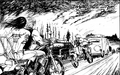 Nomad tribes traversing the Great Plains States.

References
- ↑ 1.0 1.1 MACDONALD, M. Home of the Brave. 1st ed. Berkeley CA: R. Talsorian Games. 1992 (pg.114-115)