Dixie
Dixie is a region of the USA.
Overview
Formed after The Collapse, Dixie is made up of the states of Alabama, Florida, Georgia, Louisiana, Mississippi, and South Carolina.
History
Tragically, the Deep South was hard hit during the Collapse and the years after. Only the Northeast suffered worse, but the Southerners don't mind being down as long as them damn Yankees are still beneath them in the pig pile.
Nowhere has global warming and the concurrent rising sea levels caused more change than in the Deep South. Florida and Louisiana were hardest hit, losing incredible amounts of land. Mobile, Alabama also suffered, although its plight is nowhere near as well-known as that of New Orleans.
Ever since the arrival of Union troops and carpet-baggers a century and a half prior, the Deep South has never been known for its open-armed reception of poor northerners in search of work, and this was never more true than during the Collapse. Countless people, seeking to get away from the sandstorms of the West, the rotting metropolises of New England, or the droughts of the Midwest, flocked to the South in search of jobs, water, a nicer climate, or just someone they could kill for some ready cash.
This massive influx caused incredible stresses in the social structure of the South. Interstate shipping fell apart, causing widespread hunger. Atlanta, by then a very large city, felt the lack of shipping quite acutely, and was the scene of the first food riots. Soon food riots were taking place in many cities, where the 'haves' were overwhelmed by the 'have-nots'. Soon, throughout the impoverished South, life became a war of 'us' versus 'them'. Just who 'they' were depended on the speaker, but after a while the dominant side became the poor native southerners, and the primary target became 'them damn Yankees', defined as anyone born north of South Carolina.
Over the next several years there were occasional riots and a lot of civil unrest, as well as untold murders, some of them cannibalistic. The wealthy who did not have the foresight or resources to move north soon found themselves under attack, and had their belongings stolen, confiscated, or burned.
Major industries moved their main plants out of the South during this time. Once the wealthy and the Yankees were eliminated, corporations became the next target of popular attack. A few smaller plants were overrun by mobs, one such plant providing a large portion of Jackson, Mississippi with new cars. Other plants were hit by wildcat strikes as workers demanded more pay for their work in an attempt to keep up with the skyrocketing food prices. Faced with these problems, most corporate executives chose to cut their losses and pulled their plants out with the help of foreign or scab labor. This industrial exodus left the South in even worse straits, as the unemployment statistics reached staggering highs.
Eventually, the unrest in the South started to be molded into a sort of grassroots rebellion. Under the leadership of several unscrupulous opportunists (all of whom knew each other), the mob anger so prevalent in the southern cities began to be channeled into a political force like cattle being driven in to slaughter. This eventually led, between 1998 and 2000, to the reformation of the state governments of Louisiana, Mississippi, Alabama, and Georgia, putting the ringleaders in power. In the words of Harv Paulson, famed political commentator, these governments are little more than "legitimized hate groups, thriving in the South like tapeworms in a dog."
South Carolina and Florida managed to keep the reactionaries from gaining control, and have politically moderate though ineffectual-state governments. This of course leads to conflict within the southern states when voting on national issues, and since the states usually can't come to a consensus, the Dixie region does not exert much influence on national politics. This problem is only exacerbated by the grudges held by the gulf coast state governments, as they try to browbeat Florida and South Carolina into taking orders properly by voting against any federal program that might benefit these two states.[1]
The Social Situation
Dixie is poor, dirt poor. Only South Carolina has some modicum of economic wealth, and that's primarily because they tax all shipments that cross their state to the rest of Dixie. The wealthy and the landowners of the South have all been killed, robbed, or forced to move to other, calmer states. All that remains are the poor and a few of the lower middle class who are trying to rebuild the southern economy.
The state governments of Louisiana, Mississippi, Alabama, and Georgia are powerful, corrupt, and arbitrary, earning the four states the nickname 'cotton republics'. The governments are cronyist, handing out concessions like party favors and passing laws to keep the rest of the citizens repressed. Collectively, these four tinhorns have been satirized by political cartoonists as the Marx brothers of the mid-20th Century comedy movies or the Menage a Quatre of the early 21st snuff-sex film industry.
Part of the way the cotton republics keep their citizenry down is through the Uniform Dixie Manufacturer's List Code, a region-wide control system for items and substances the powers that be want to keep out of the hands of John Q. Public. Among the restrictions of the Code are several laws which are anathema to most cyberpunks.
For example, Dixie (Florida excepted) has the strictest gun control regulations anywhere in the states. The only weapons legal for the citizenry to carry are shotguns and .22 caliber hunting rifles, and these must be registered at an exorbitant fee. Those with registered firearms also get a bar-code tattoo on the back of their neck for identification purposes. Punishments for illegal weapons or tampering with the tattoo are extreme. Despite their efforts, though, there are still a lot of unregistered weapons in Dixie. No poor southerner ever intends on giving up his ability to shoot possum when he needs to. Citizens are just careful to keep their weapons hidden, and they only use their rifles on the police when they're certain they'll never be caught. In response, the police forces perform regular sweeps, searching house-to-house for unregistered weapons.
Drugs, music, ammo, cyberware, and many other common items are also prohibited or restricted. This is a real problem when one considers that Dixie cops don't need a warrant or even probable cause to give you a full search.
The governments are all networked to a greater or lesser degree, with the ties between the cotton republics being very tight. The other two state governments are weak, as they are plagued with backstabbing infiltrators and cronyist sympathizers who hamstring any socially useful programs they attempt to create.
For most of the United States, public opinion does not go past Dixie's poverty and arrogant governments. Sadly, it should, for despite their low economic position and governmental repression, the typical southerner is still gregarious, social, and generous. The rioting crowds that dominated the American media were an aggressive minority, and their sweeping path to power was in large part a media circus and a study in mob psychology. Most southerners can't believe it happened to them, but all they can do is shake their heads while they till their desolate fields, and look the other way when the sheriff drives by in his old-fashioned hovercar.[1]
Gallery
-
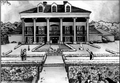 Louisiana in 2020

References
- ↑ 1.0 1.1 MACDONALD, M. Home of the Brave. 1st ed. Berkeley CA: R. Talsorian Games. 1992 (pg.99-101)